

Key Points
- MNIT Jaipur to host quantum computing and AI labs under MeitY project
- Students gain access to Lam Research Semiverse semiconductor training platform
- Over 100 student-designed chips fabricated at SCL Mohali under C2S programme
The Ministry of Electronics and Information Technology (MeitY) will establish an Advanced Quantum Computing and Quantum Communications Lab at Malaviya National Institute of Technology (MNIT), Jaipur, Union minister Ashwini Vaishnaw announced on Thursday (12 June). A separate Artificial Intelligence Lab will also be set up at the institute under the ministry’s Electronics and ICT Academic Project.
The quantum lab will focus on building indigenous capabilities in three critical areas: Quantum Key Distribution (QKD), which is a method of secure communication that uses quantum mechanics to encrypt data in a way that makes eavesdropping detectable; quantum computing simulation; and quantum sensing hardware components. Vaishnaw said the QKD research carries particular importance for national security applications.
EVENT

VeeamON 2026 Tour India – Delhi
A VeeamON 2026 India Leadership Series Delhi for senior public sector and government technology leaders.
EVENT


Infosec Reimagined
Infosec Reimagined 2026 is the premier information security summit where top leaders—CISOs, CROs, CIOs, CTOs and risk executives—converge to redefine cyber resilience.
EVENT


Digital Senate
Digital Senate is a premier conference uniting government leaders, technologists and innovators to share ideas, success stories and strategies on digital governance, public sector transformation, cybersecurity and emerging technologies in India.
EVENT


CIO Prism
CIO Prism unites forward-thinking technology leaders to exchange transformative insights, shape digital strategies, and foster innovation, empowering enterprises to excel in an era of rapid technological change.
“While the current technological wave is being driven by AI, the next major technological wave will be led by Quantum Technology,” Vaishnaw told students and faculty members at MNIT Jaipur.
He urged the institute to take a leadership role in post-quantum cryptography, which refers to encryption methods designed to remain secure even against attacks from future quantum computers that could break current encryption standards.
Semiconductor training
Vaishnaw also announced that MNIT Jaipur students will gain access to Lam Research’s Semiverse platform, a digital twin-based semiconductor fabrication and training ecosystem. A digital twin is a virtual replica of a physical system that allows users to simulate and study real-world processes without accessing actual equipment.
Through Semiverse, students can study semiconductor chip structures in three dimensions, understand chip manufacturing processes and simulate fabrication steps in a virtual environment. This addresses a critical training gap in India’s semiconductor workforce development.
The minister said there is demand for more than one million semiconductor design professionals, citing industry estimates. He noted that companies including NVIDIA, Qualcomm, ARM and AMD are already designing advanced semiconductor chips at 2 nanometre and 3 nanometre process nodes in India, made possible by the country’s existing design workforce.
Under the Chips to Startup (C2S) Programme, the government is providing Electronic Design Automation (EDA) tools to more than 323 universities across India. EDA tools are specialised software that engineers use to design and test semiconductor chips before they are manufactured.
Advertisement
The programme provides state-of-the-art design tools from leading companies including Synopsys, Cadence and Renesas. Using these tools, more than 100 student-designed chips from institutions across India have been fabricated at Semiconductor Laboratory (SCL), Mohali.
“The work to be undertaken under this project will be of significant importance for the country,” Vaishnaw said, encouraging students to make full use of the advanced EDA tools available to them.
AI lab to connect with IndiaAI mission
The AI Lab at MNIT Jaipur will provide facilities including advanced compute infrastructure and research tools. The lab will be connected to the network of the IndiaAI mission, the government’s programme to build artificial intelligence capabilities across research institutions and industry.
Vaishnaw highlighted related work being carried out at Indian Institute of Technology Jodhpur on deepfake detection technology as an example of the research direction the new lab could pursue.
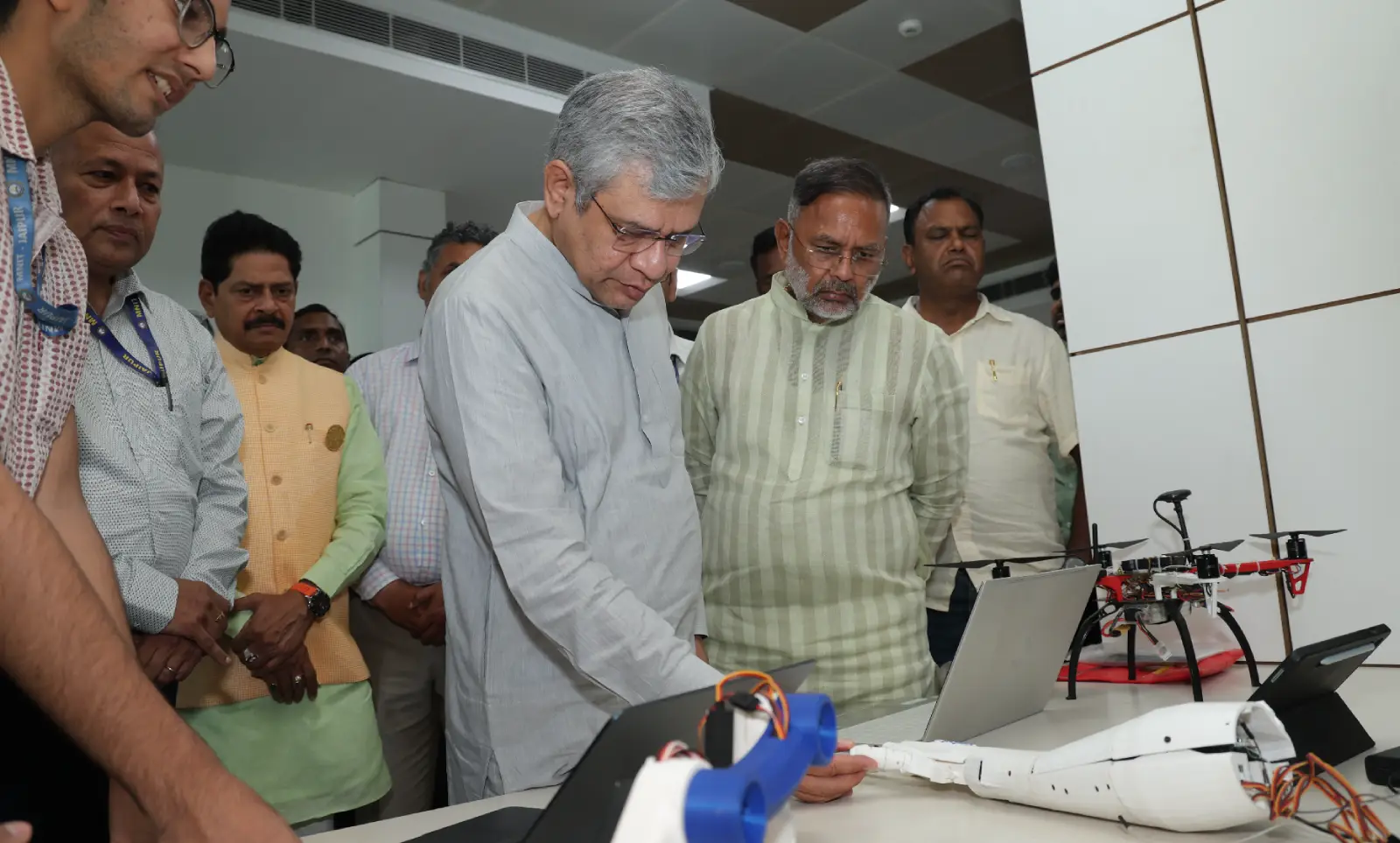
The minister, along with Heeralal Nagar, minister of state for Energy in the Government of Rajasthan, and Gopal Sharma, member of the Rajasthan Legislative Assembly representing Civil Lines Jaipur, inaugurated a Makers Lab at MNIT Jaipur during the visit.
By the numbers
- 1 million+
- Semiconductor design workforce demand
- 323
- Universities with EDA tools under C2S
- 100+
- Student chips fabricated at SCL Mohali
The Makers Lab will provide students with experiential and hands-on training opportunities in both software and hardware technologies, including sensors, embedded systems, compute devices and electronics systems.
During his visit, Vaishnaw interacted with students and faculty members. Students demonstrated projects and applications in the fields of AI, robotics, drones, structural engineering and post-quantum cryptography.
Your Questions, Answered
What will the quantum lab at MNIT Jaipur focus on?
The lab will focus on Quantum Key Distribution for secure communications, quantum computing simulation and quantum sensing hardware components. QKD research is particularly important for national security applications.
What is Lam Research’s Semiverse platform?
Semiverse is a digital twin-based semiconductor fabrication and training ecosystem. It allows students to study chip structures in 3D, understand manufacturing processes and simulate fabrication steps in a virtual environment.
How many universities have access to EDA tools under the Chips to Startup programme?
More than 323 universities across India have access to Electronic Design Automation tools from companies including Synopsys, Cadence and Renesas under the C2S Programme.
How many student-designed chips have been fabricated under the C2S programme?
More than 100 student-designed chips from institutions across India have been fabricated at Semiconductor Laboratory, Mohali, using EDA tools provided under the programme.